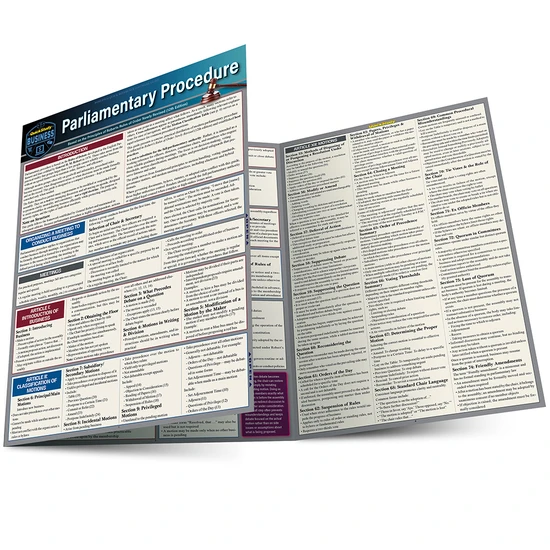


Essential guide to the principles of Robert’s Rules of Order (12th edition) in a quick and easy reference for navigating formal meetings where following the rules of engagement are required to participate. Indispensable for participants new to the format and a great way to find answers fast during meetings where time is critical. Often used in meetings held by nonprofit boards, corporate boards, local government bodies, civic associations, school boards, trade unions, and religious congregations, the structure ensures all voices are heard by the majority, with order, providing dignity to the participants wishing to achieve their goal. Use funds to truly help by making a set of guides available that can be used by attendees that will strengthen the format ensuring rules are followed, voices are heard, and goals are achieved in the time allotted.
6 page laminated guide includes
- Introduction
- Organizing a Meeting to Conduct Business
- Selection of Chair & Secretary
- Meetings
- Article I: Introduction of Business
- Section 1: Introducing Business
- Section 2: Obtaining the Floor
- Section 3: What Precedes Debate on a Question
- Section 4: Motions in Writing & Division
- Section 5: Modification of a Motion by the Maker
- Article II: Classification of Motions
- Section 6: Principal/Main Motions
- Section 7: Subsidiary/Secondary Motions
- Section 8: Incidental Motions
- Section 9: Privileged Motions
- Article III: Motions & Order of Precedence
- PRIVILEGED MOTIONS
- Section 10: Setting Adjournment Time
- Section 11: Motion to Adjourn
- Section 12: Questions of Privilege
- Section 13: Orders of the Day
- INCIDENTAL MOTIONS
- Section 14: Appeal (Questions of Order)
- Section 15: Objection to Consideration
- Section 16: Reading of Papers
- Section 17: Withdrawal of a Motion
- Section 18: Suspension of the Rules
- SUBSIDIARY MOTIONS
- Section 19: Motion to Table
- Section 20: Previous Question
- Section 21: Postpone to a Certain Time
- Section 22: Refer to Committee
- Section 23: Amendments
- Section 24: Postpone Indefinitely
- MISCELLANEOUS MOTIONS
- Section 25: Rescind
- Section 26: Renewal of a Motion
- Section 27: Reconsider
- PRIVILEGED MOTIONS
- Article IV: Committees / Informal Action
- Section 28: Committees
- Section 29: Forms of Reports
- Section 30: Receiving Reports
- Section 31: Adopting Reports
- Section 32: Forming a Committee of the Whole
- Section 33: Informal Consideration of Questions
- Article V: Debates & Decorum
- Section 34: Debate
- Section 35: Not Debatable Questions / Opening the Main Question to Debate
- Section 36: Decorum
- Section 37: How to Close Debate
- Article VI: Voting
- Section 38: Voting
- Section 39: Requiring More Than a Majority Vote
- Article VII: Officers & Minutes
- Section 40: Duties of Chair/President
- Section 41: Duties of Clerk/Secretary
- Article VIII: Miscellaneous
- Section 42: Session
- Section 43: Quorum
- Section 44: Order of Business
- Section 45: Amendment of Rules of Order
- Article IX: Organization & Meetings
- Section 46: Occasional or Mass Meetings
- Section 47: Conventions & Assemblies of Delegates
- Section 48: Permanent Societies
- Section 49: Governing Documents
- Article X: Officers & Committees
- Section 50: Chair/President
- Section 51: Clerk, Secretary, Recording Secretary
- Section 52: Treasurer
- Section 53: Committees
- Article XI: Introduction of Business
- Section 54: How to Introduce Business
- Article XII: Motions
- Section 55: Methods of Disposing of or Postponing a Resolution Under Discussion
- Section 56: Modify or Amend
- Section 57: Deferral of Action
- Section 58: Suppressing Debate
- Section 59: Suppressing the Question
- Section 60: Reconsidering the Question
- Section 61: Orders of the Day
- Section 62: Suspension of Rules
- Section 63: Papers, Privileges & Withdrawal of Motions
- Section 64: Closing a Meeting
- Section 65: Order of Precedence Summary
- Section 66: Voting Thresholds Summary
- Section 67: Determining the Proper Motion
- Section 68: Standard Chair Language
- Section 69: Common Procedural Misunderstandings
- Section 70: Tie Votes & the Role of the Chair
- Section 71: Ex Officio Members
- Section 72: Quorum in Committees
- Section 73: Loss of Quorum
- Section 74: Friendly Amendments
- Section 75: Handling Disruptive Members
- Section 76: Proxy Voting
- Section 77: Abstentions
- Section 78: Role of the Parliamentarian
- Section 79: Principles of Impartiality & Disclosure
- Section 80: Ratification
- Article XIII: Modern Parliamentary Practice
- Section 81: Electronic Meetings
- Section 82: Hybrid Meetings
- Section 83: Electronic Voting
- Section 84: Notice Requirements
- Section 85: Consent Agenda
- Section 86: Executive Session
- Section 87: Recusal & Conflicts of Interest
- Section 88: Minutes & Record Retention
- Section 89: Parliamentary Authority
- Section 90: Suspension of Rules in Modern Context
- Section 91: Removal from Office
- Section 92: Discipline of Members
- Section 93: Resignation of Officers
- Section 94: Filling Vacancies
- Section 95: Elections & Nominations
- Challenges & Corrections
- Section 96: Special Rules of Order
- Section 97: Appeal in Modern Practice
- Section 98: Use of Technology in Meetings
- Section 99: Transparency & Open Meetings
- Section 100: Amendment of Governing Documents
- Section 101: Parliamentary Procedure & Law
- Section 102: Fundamental Principles
- Section 103: When Procedure Breaks Down
- Parliamentary Procedure at a Glance
- Motion Classification Table